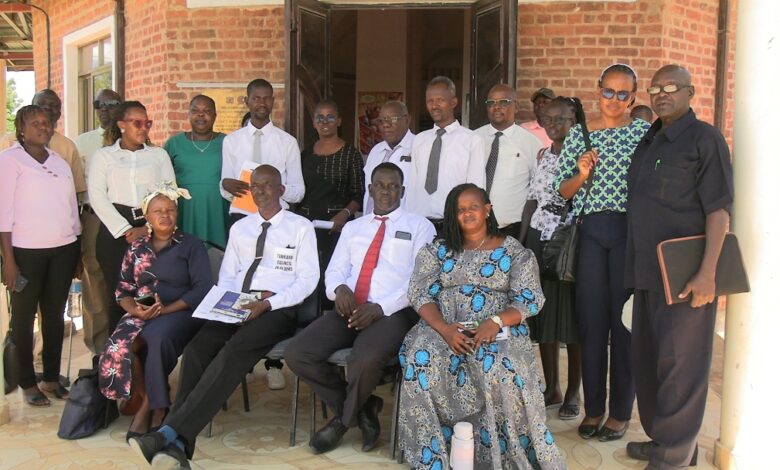
LODWAR: Alternative Justice System (AJS) leaders in Turkana have called for increased public awareness and support to strengthen access to justice through community-based dispute resolution mechanisms.
The call came during a one-week AJS training and familiarisation programme that brought together panelists from across the county, including Naduat, Lokichar, Kakuma and Lodwar.
The programme, supported by the Food and Agriculture Organization (FAO) and the County Government of Turkana, sought to equip AJS panelists with the knowledge and skills needed to handle disputes at the community level while ensuring that alternative justice mechanisms operate within the law.
During the training, participants were taken through the AJS framework, their roles and responsibilities, and practical approaches to resolving community disputes. They also shared experiences and discussed challenges affecting access to justice.


The panelists later elected their leadership, with with Court Administrator for the Lodwar Law Courts, Mr. John Lotir elected chairman and Betty Lorogoi as deputy chairperson.
Speaking during the programme, Eregae Samwel Emanman, who represented the Turkana County Council of Elders, called for greater support for elders through civic, legal and cultural education.
Emanman said elders need a better understanding of the relationship between customary practices and the law, particularly in cases where certain cultural practices may conflict with legal requirements.
He cited practices such as marrying off young girls to older men in exchange for wealth, saying increased legal and cultural awareness could help communities protect children’s rights and promote education.
Meanwhile, newly elected AJS chairman John Lotiir said the system would provide communities with a faster and more affordable avenue for resolving disputes.
Lotiir disclosed that the AJS Centre currently has 78 pending cases, most of which accumulated during the period when AJS services were not operational. He expressed confidence that the cases could be cleared within a reasonable period once the centre becomes fully operational.
He urged residents to consider AJS when seeking to resolve disputes, noting that the system could reduce the financial and time burden associated with conventional court processes.
The leaders emphasized that strengthening AJS at the grassroots will require continued training, public awareness and collaboration among elders, government agencies, the Judiciary and development partners.
WATCH INTERVIEW