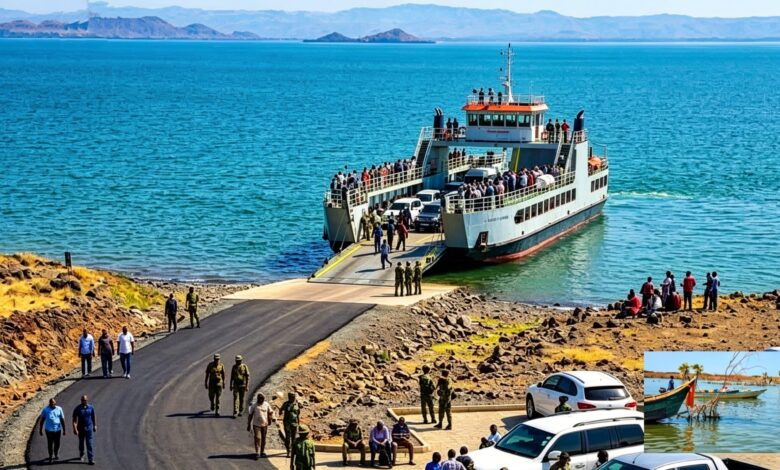
Lodwar — As plans gain momentum to introduce ferry services across Lake Turkana and unlock the region’s blue economy potential, concerns have emerged over whether Turkana County is fully leveraging opportunities arising from several major lake-related initiatives.
Information obtained from reliable sources familiar with several initiatives suggests that while Turkana County has been involved in numerous projects targeting Lake Turkana transport, fisheries trade, and general lake-related economic development, inadequate technical engagement may be limiting the county’s pivotal role in taking its rightful position and influence for proper benefits.
According to the sources, who requested anonymity due to the sensitivity of the matters, some Technical Officers and Professionals tasked with or in a position to advise the political class are not doing enough to effectively represent the County’s interests.
At the center of the discussion is the proposed Lake Turkana Ferry Project, a long-term initiative aimed at establishing maritime transport linking Turkana and Marsabit counties.

The project reportedly traces its origins to the tenure of former Principal Secretary for Shipping and Maritime Affairs, Amb. Geoffrey Kaituko, who championed efforts to improve maritime transport and investment opportunities in Lake Turkana.
The project falls under the Ministry of Mining, Blue Economy and Maritime Affairs domiciled in the State Department for Shipping and Maritime Affairs, and forms part of broader government efforts to realize the economic potential of Kenya’s largest lake.
The ferry project was conceptualized years before several national projects in the region, including the Kenya Fisheries Service (KeFS) patrol vessel, the fish markets, and Youth training at bandari marine Academy.
Ferry Project Seen as Key to Regional Trade
Once operational, ferry services are expected to transform the movement of people and goods across the vast lake, significantly reducing travel times between communities in Turkana and Marsabit counties
The project is envisioned as a catalyst for trade, tourism, fisheries development, livestock movement, and regional integration, particularly among the shoreline settlements in both counties.
A feasibility and viability study being undertaken by Kenya Ports Authority and Kenya Ferry Services is expected to determine the most suitable routes, infrastructure requirements, and operational framework for the proposed service. Other benefits from the project include a management plan for the Lake that is under development, with technical teams from both National government agencies and county governments of Turkana and Marsabit counties
However, there are concerns regarding Turkana County representation in the project. It’s worth noting that the county was allowed to nominate a technical person for engagement and representation.
Now that little is shared or talked about by the county, then questions are raised about the involvement of the nominee, County Officials, and relevant County Departments!
Why is the county silent on several national initiatives in the region? How effective is county representation on the projects? What is limiting the county’s participation? What is the priority of the technical people within the Turkana County administration? Are they prioritizing people’s interests or prioritizing personal interests over the county’s development agenda, resulting in inadequate engagement?
Another project with notable poor coordination or involvement is the development of Kalokol Fish market, which technically requires the ministries of Trade and Agriculture working together. As construction is ongoing, national government departments are fully aware of what is happening, but the technical county Ministries seem not to be aware.
“Can the county departments of trades, cooperatives, Fisheries and administration separately report comfortably on the progress?” asked one of the sources. The County departments that are directly affected by the project implementation are not reading from the same page.
Lake Turkana at the Heart of Blue Economy Investments
Beyond the ferry proposal, Lake Turkana has become a major focus of National and County Government investment. This is outlined under Kenya’s Fourth Medium Term Plan (MTP IV) 2023–2027 and Counties (Turkana and Marsabit) Integrated Development Plans. At both levels, there are efforts to maximally benefit from the transboundary resource
Among key programmes are the Sustainable Unlocking of Lake Turkana’s Economic Potential Project, funded by the Dutch Embassy and implemented by the World Food Programme (WFP), UNESCO, and local partners in both counties. The programme seeks to improve livelihoods, strengthen fisheries value chains, enhance environmental conservation, and support sustainable utilization of the lake’s resources with a Floating Jetty for fish landing, a notable infrastructure in the region.
Significant investments have also been made in Fisheries infrastructure, including the ongoing fish markets in Kalokol and Lowarengak in Turkana County, and Loiyangalani in Marsabit County, and the proposed Floating Jetty for fish landing by WFP. The Lake Turkana Maritime Transport Project is also being pursued as part of wider efforts to improve connectivity and stimulate economic activity across the region.
National government agencies, including the State Department for Blue Economy and Fisheries, Kenya Fisheries Service (KeFS), the Kenya Marine and Fisheries Research Institute (KMFRI), State Department for Shipping and Maritime Affairs, and the Kenya Maritime Authority (KMA) have expanded their presence (offices in both counties) around the lake to support Fisheries management, research, development, and Rescue. Other national agencies with a presence in the region include the Kenya Coast Guard Services and the Kenya Wildlife Service.
Strengthening Lake Turkana Fisheries Management
There are several milestones achieved in recent years that include legal frameworks developed in the recent past, including the regulations aligned with the Fisheries Management and Development Act (FMDA). The FMDA Beach Management Unit regulation 2024 provided guidance on the establishment Beach Management Unit (BMU) networks from the ward to the National level.
The regulation facilitated the establishment of Lake Turkana Water Beach Management Unit network, county BMU networks and Ward BMU networks aimed at improving coordination among fishing communities and enhancing rescue operations across the lake. This is also a key structure to improve community participation in key developments and public participation.
KeFS also procured a patrol boat valued at approximately KSh50 million and stationed it at Kalokol to strengthen surveillance, safety, and fisheries enforcement activities.
Additionally, Kenya Coast Guard Services, Kenya Wildlife Service and Turkana County Government have operational rescue boats stationed at different points along the lake. The various boats are meant to improve surveillance and rescue missions in case of accidents.
KeFs has also further developed the Lake Turkana Fisheries Management Plan (2025–2030), which aims to promote sustainable exploitation of fisheries resources while safeguarding the lake’s ecological health.
Through collaboration partnership, KeFS, KMFRI, Both County governments, BMU networks, and the State Department for Fisheries, stakeholders also conducted comprehensive surveys (the first ever in Lake Turkana) namely frame and Acoustic survey. The surveys have established critical baseline data on fish population, fishermen, fishing vessels, fishing gear, landing sites, and related infrastructure across the lake.
Expanding Fish Markets and Cold Storage Facilities
Efforts to improve fish value chains are also ongoing.
In Partnership, the County Government has established fish markets Kakuma (Towokayeni) and Lokiriama, while improvements have been undertaken at Lodwar’ (Natogo ) Fish Market. The various interest sand initiatives have also attracted private partners in the region investing in cold chain facilities in Lodwar, Kakuma, Kerio, Katiko, Loiyangalani. With high potential, community members have also single-handedly developed a new fish market (Naruko Fish Market) in Kanamkemer Ward.
Under the current leadership, both county governments established functional standalone County Departments of Fisheries fully operational with County Chief officers, Directors and technical staff. The opportunity aimed at exploring Lake Turkana not only for food security but also for economic growth. The Turkana County government is also in the process of improving visibility in the sector, including the ongoing development of the Fisheries and Aquaculture bill and improving fishing effort and post-harvest management.
The Frontier Counties Development Council (FCDC) is also actively involved in plans to improve the benefits from Lake Turkana. There have also been several questions raised on the floor of the National assembly about the underdevelopment of lake Turkana and the negative impacts of raising lake water levels.
Future Hinges on Collaboration
While acknowledging the progress made, the sources maintained that stronger coordination between county and national government institutions will be necessary to maximize the benefits of the ongoing, planned, and intended initiatives.
For instance, if implemented successfully, the ferry project would not only connect Turkana and Marsabit counties more efficiently but also serve as a cornerstone for regional trade, tourism, and sustainable economic development across the Lake Turkana basin.
There is also a need by the county government to communicate the efforts or activities they are engaged in as far as the Lake Turkana development is concerned.
With billions of shillings being invested in maritime transport, fisheries & trade infrastructure, and blue economy initiatives, the success of the proposed Lake Turkana ferry service could become a defining milestone in efforts to transform the economic fortunes of communities living along Kenya’s largest lake.